
How I’m Thinking About Goals This Year
Not advice, just how I’m approaching it

Hello friends and welcome to 2026. I hope you spent the holidays doing something fun and with people you love. I know I did.
But the party’s over and it’s time to lock in. The crew at No Laying Up released their annual Goals podcast last week and it’s always one of my favorites. In that spirit, I wanted to share thoughts on my goals for this week’s post. Sidenote - if you have some free time I highly recommend giving it a listen.
I used to be like Vince Vaughn in Dodgeball and never really set goals for myself. It felt phenomenal.
But as I’ve gotten older I’ve become a big goals guy. I realized that I like having some structure, and I’ve found that organizing my goals and resolutions into a few buckets helps me stay focused. For me, those buckets are Health, Wealth, Relationships, Experiences, and Professional.
I’m not gonna go full Andrew Huberman on you and tell you to start waking up at 5am every day and do three hours of meditation, cold plunge, and zone 3 cardio before having your morning coffee. But I do enjoy thinking about this stuff, and I wanted to share a couple different perspectives on goals that I’ve found helpful along the way. Maybe you will too.
Identity Change
Atomic Habits is one of the most popular productivity books out there. I’ve read it twice and highly recommend it. One of the core ideas that’s really stuck with me is around building identity-based habits:
Improvements are only temporary until they become part of who you are.
The goal is not to read a book, the goal is to become a reader.
The goal is not to run a marathon, the goal is to become a runner.
The goal is not to learn an instrument, the goal is to become a musician.
Every action you take is a vote for the type of person you wish to become. No single instance will transform your beliefs, but as the votes build up, so does the evidence of your new identity.
This year, focus on the identity you want to build.
I really like this framework.
From the Health bucket, my goal is to be someone who prioritizes health without overthinking it. That means committing to simple strength training workouts, dialing in my supplements, not wasting time doomscrolling in bed every morning, and a few other things that I’ll keep private. Simple stuff that I can maintain over the long term, not in streaks or quick fixes.
From the Professional bucket, I want to shift from being reactive to more intentional about my career. You always hear people say success is some combo of hard work and a little luck. Working hard speaks for itself, but I want to get better at creating chances for that luck to find me. Sahil Blooms calls it “increasing your surface area for luck.” This means changing my approach. I need to do a better job of expanding and maintaining my network - checking in, staying connected, offering help when I don’t need anything in return. I also want to provide value consistently. I believe putting myself out there, building my personal brand, and sharing my thinking publicly will create momentum and unlock opportunities over time. That means staying consistent with this newsletter and embracing a little self-promotion.
On that note:
Follow me on Instagram, Twitter, and if you aren’t already:
A huge reason people don’t stick with their resolutions is because they assign a specific outcome to a goal (lose ten pounds, dry January, etc) and once they check the box, they go back to their old ways. This year, I’m trying to focus less on outcomes and more on identity.
Anti-Goals
Over the holidays I read Never Enough: From Barista to Billionaire which tells the story of Andrew Wilkinson’s career and the entrepreneurial path that eventually made him a billionaire.
A few years in, despite enormous financial success, he found himself unhappy. To reset, he took inspiration from Charlie Munger, who talks about inversion, or reversing problems to solve them.
Problems frequently get easier if you turn them around in reverse. In other words, if you want to help India, the question you should ask is not ‘how can I help India,’ it’s ‘what is doing the worst damage in India and how do I avoid it?
A lot of success in life and business comes from knowing what you want to avoid: early death, a bad marriage, etc.
Wilkinson turned this idea into what he calls Anti-Goals.
Instead of thinking through what we wanted our perfect day to look like, we thought about the worst day imaginable and how to avoid it.
One example: after burning out on days packed with long meetings, he set a simple rule - never schedule an in-person meeting if it could be handled over email, a call, or skipped altogether.
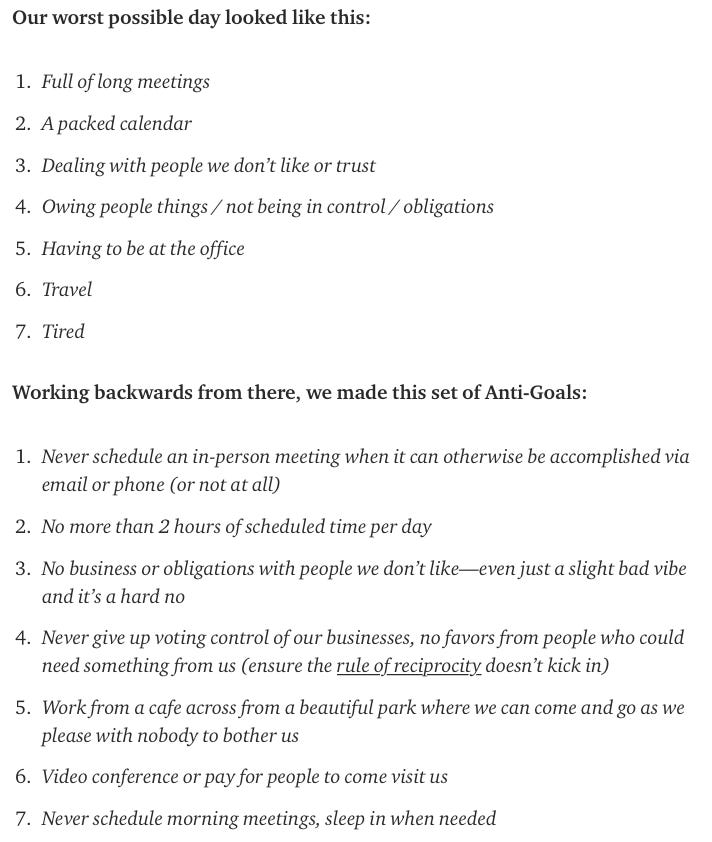
Most of these are not realistic for everyone, especially if you don’t work for yourself, so here’s a few more relatable ideas.
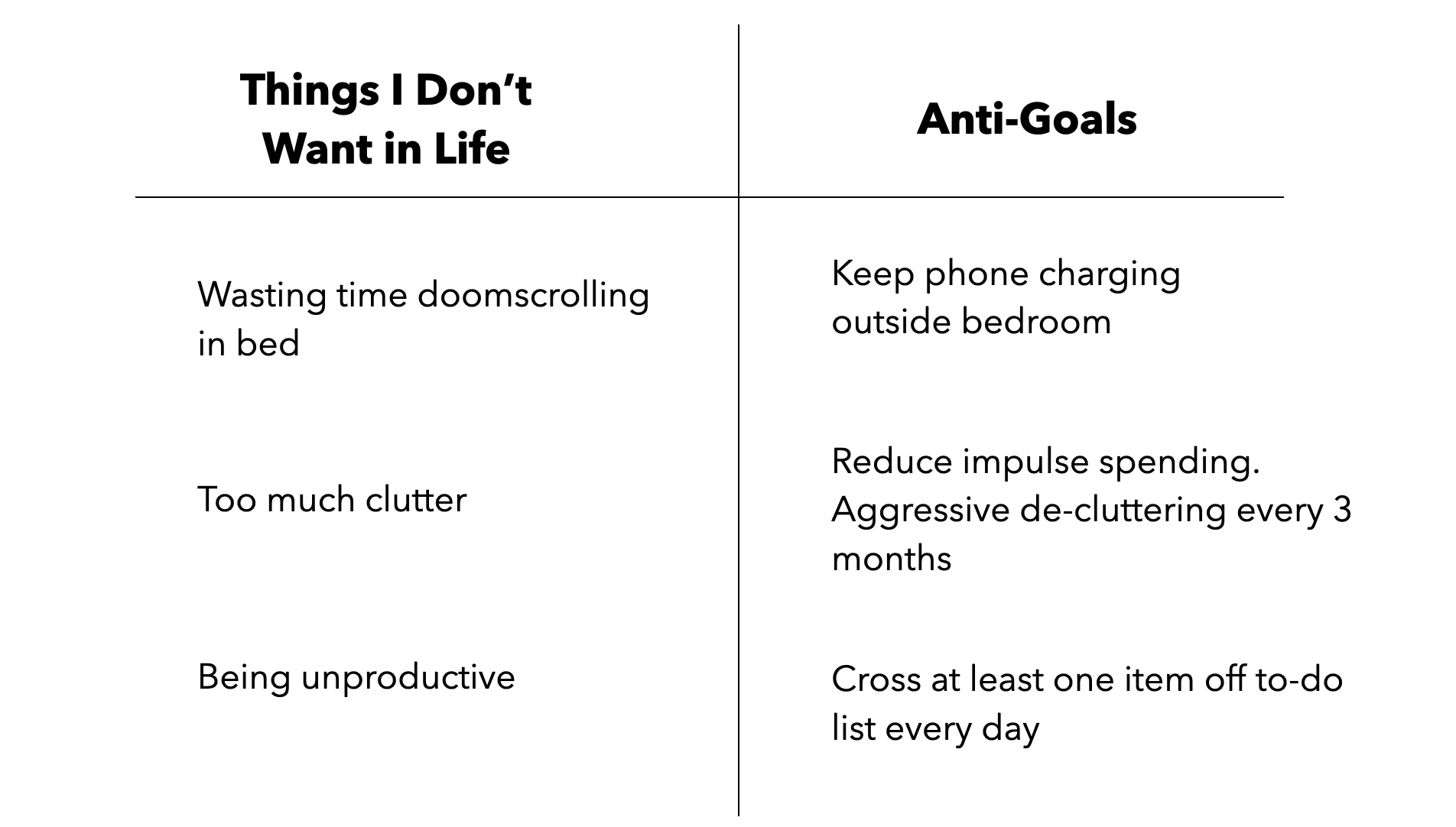
As I think through my own career transition, I’ve found this concept really useful too. I’m spending just as much time defining what I don’t want in my next role as I am defining what I do.
Anyway, that’s how I’m thinking about goals heading into 2026. Not claiming I have it all figured out, just sharing what’s been helpful for me so far. In the spirit of accountability here’s where I landed on with my 2026 goals, with a few redacted for privacy.
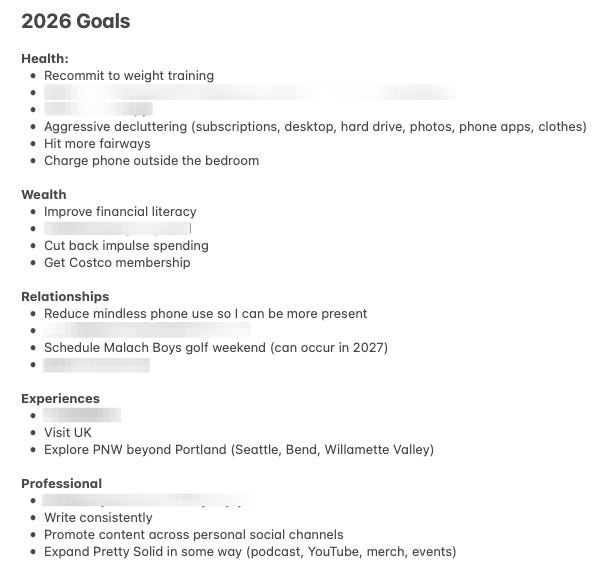
Feel free to reply with a few goals of your own. And if you have any approaches or systems you swear by, send em over. Always down to steal good ideas.
Let’s make 2026 a great year.
This Week in AI
Google and Anthropic just made circling back a whole lot easier. Now I see why Sam Altman declared Code Red at OpenAI last month.
Three Things I Liked This Week
Bill Simmons’ 50 Most Rewatchable Movies of the 21st Century - peak Simmons. Incredible podcast and nearly perfect list. No notes.
What to Cook When You Don’t Feel Like Cooking - this cookbook has brought some inspiration back into our kitchen. Approachable recipes that are easy and fun to cook.
Between the holidays, playoff football, and all the geopolitical chaos to kick off the year, the memes have been on point.
 Work Retire Die@WorkRetireDieSorry my bad - when i said 'let's pick this back up in the new year,' I meant 'let's never speak of this again.' Should've been more clear7:14 PM · Jan 5, 2026 · 182K Views2 Replies · 768 Reposts · 9.56K Likes
 will depue@willdepuetrillion dollar idea: sports bar but just for situation monitoring with live X feeds, flight radar, a bloomberg terminal, and Polymarket screens6:13 AM · Jan 6, 2026 · 4.06M Views1.34K Replies · 3.31K Reposts · 50.6K Likes
 Not Jerome Powell@alifarhat79
 2:01 PM · Dec 26, 2025 · 12.3K Views6 Replies · 16 Reposts · 170 Likes


Thanks for reading, and enjoy the rest of your week.